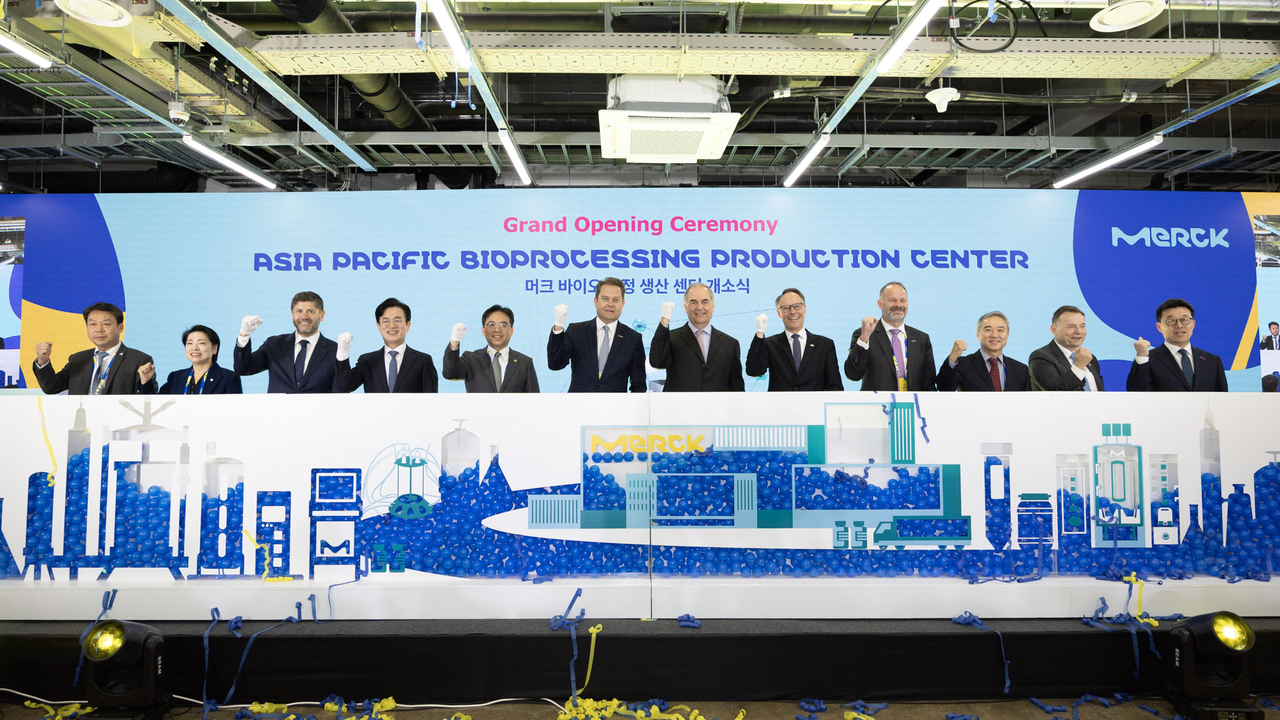
German science and technology company Merck has opened a $334 million bioprocessing plant in Daejeon, its largest life science investment in Asia-Pacific, as it seeks to bring production closer to regional drugmakers.
The company said Thursday that the 44,500-square-meter facility in Dungok, Daejeon, will manufacture critical materials used in the development and production of biologic medicines, strengthening supply chains for drugmakers across the region.
The plant will produce dry powder and liquid cell culture media, process liquids, cleaning solutions and single-use sterile sampling systems. It will also supply customized materials for early-stage drug development.
By manufacturing these products closer to customers, Merck aims to shorten supply chains and improve the reliability of materials needed throughout biologics production.
"Reliable access to critical materials is essential at every stage of biologics manufacturing," said Jean-Charles Wirth, CEO of Merck's life science business. "Daejeon brings advanced production closer to biopharma manufacturers across Asia-Pacific, giving them greater supply confidence as they move from development to commercial scale."
The facility will use raw materials free of animal-derived component in its cell culture media and process liquids, while automated digital systems will track production batches and support quality control and regulatory compliance.
Merck said the plant was designed to operate without on-site fossil fuel use, incorporating solar power, heat pumps and energy recovery systems. Rainwater reuse systems will also help reduce water consumption.
Daejeon Mayor Heo Tae-jeong pledged to strengthen cooperation between Merck and local universities, research institutions and businesses to support the city's biotechnology industry.
The investment is part of Merck's "in-region-for-region" strategy, which aims to bring production closer to customers and strengthen regional supply resilience.
The company has also expanded its life science operations through investments in drug testing facilities in Darmstadt, Germany, and filtration manufacturing in Blarney, Ireland.
yejinlim@heraldcorp.com